-6.png)
Investment Property Tax Deductions in Australia

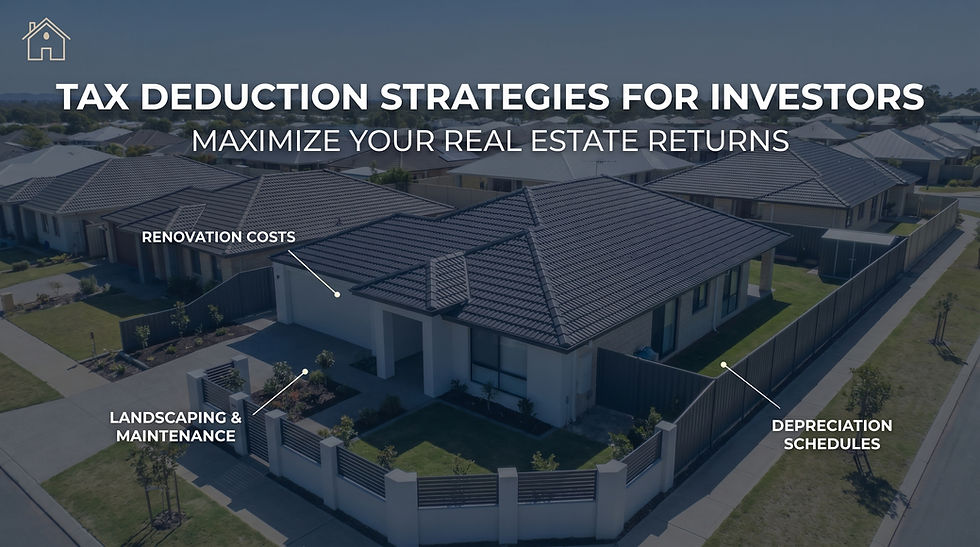
Tax time is where property investors either leave money on the table or, worse, claim something they shouldn't and invite an ATO audit. The difference between a good tax outcome and a bad one often comes down to knowing which expenses fall into which bucket.
This guide breaks down every deduction category the ATO recognises for residential rental properties, with the rules that trip investors up most often.
The Three Categories of Rental Expenses
According to the ATO, every rental expense falls into one of three categories:
Expenses you can claim now (in the income year you incur them), such as interest on loans, council rates, repairs and maintenance, and depreciating assets costing $300 or less.
Expenses you claim over several years, such as capital works, borrowing expenses and the decline in value of depreciating assets.
Expenses you can't claim, such as personal expenses, acquisition costs and (for most individual investors) second-hand depreciating assets purchased after 9 May 2017.
Getting the category right matters. Claiming a capital expense as an immediate deduction is one of the most common errors the ATO flags.
Immediate Deductions: What You Can Claim This Year
The ATO lists the following as common rental expenses you can claim an immediate deduction for, provided your property is rented or genuinely available for rent:
Advertising for tenants
Body corporate administrative fund fees and charges
Council rates, water charges, land tax
Cleaning, gardening and lawn mowing
Pest control
Insurance (building, contents, public liability, loss of rent)
Interest expenses
Property agent fees and commissions
Repairs and maintenance
Legal expenses (certain types only)
To claim a deduction, you must have actually incurred the cost yourself. You can't claim expenses paid by the tenant or someone else.
Interest on Your Investment Loan
For most investors, interest is the single largest deduction. You can claim interest on a loan used to:
Buy a rental property
Buy a depreciating asset for the property (such as an air conditioner)
Pay for deductible expenses (like repairs)
Finance renovations and extensions
The critical rule: if you use part of the loan for private purposes, you can only claim the rental portion. The ATO gives this example: if you borrow $400,000 and use $380,000 for a rental property and $20,000 for a private car, you calculate the deductible portion as $380,000 / $400,000 = 95%. That ratio applies for the life of the loan.
You also can't claim interest for any period the property is used for private purposes, even briefly.
Insurance
Building, contents, public liability and loss of rent insurance are all deductible in the year you pay them. If you pre-pay an annual premium part way through the income year, you can generally claim the full amount immediately provided the eligible service period is 12 months or less and ends in the next income year.
Council Rates, Water and Land Tax
These are straightforward immediate deductions, claimed in the year you incur them. If your property is only rented for part of the year, you'll need to apportion.
Property Management Fees
Agent fees and commissions are fully deductible in the year incurred. You don't need to apportion these even if your property was vacant for part of the year, because they relate solely to the income-producing activity.
Legal Expenses
You can claim legal costs for:
Evicting a non-paying tenant
Court action for loss of rental income
Defending a claim for damages from injuries on your rental property
Most other legal expenses relating to your rental property (like purchase conveyancing) are capital in nature and can't be claimed as an immediate deduction.
Repairs and Maintenance: Where Most Mistakes Happen
The ATO draws a firm line between repairs, maintenance, improvements and initial repairs. Getting this wrong is one of the fastest ways to attract scrutiny.
Repairs (Immediate Deduction)
Repairs fix defects, damage or deterioration that occurred while you rented the property out. Examples the ATO accepts as immediate deductions:
Replacing a cracked window pane
Replacing part of a gutter
Replacing part of a fence
Repairing electrical appliances or machinery
Maintenance (Immediate Deduction)
Maintenance prevents deterioration or fixes existing deterioration. Examples include:
Repainting faded or damaged internal walls
Oiling a deck or cleaning a swimming pool
Maintaining plumbing
Improvements (Capital, Not Immediate)
An improvement makes part of the property better, more valuable, more desirable, or changes the character of the item. These must be claimed as capital works deductions over time, not as an immediate repair.
The ATO gives a useful example: if you replace a damaged fibre cement wall with plasterboard (a current equivalent material), that's a repair. If you replace it with a brick feature wall, that's an improvement because you changed the character of the wall.
Initial Repairs (Not Deductible Immediately)
This catches a lot of new investors. If you buy a property with existing damage or defects and then fix them, those are "initial repairs" and you can't claim them as an immediate deduction, even if you didn't know about the damage at purchase.
Initial repairs to the building structure can generally be claimed as capital works deductions over 40 years. The cost also forms part of your CGT cost base when you sell.
Replacing an Entire Item
Replacing an entirety (a complete, separately identifiable item) is not a repair. The ATO uses this example: if a toilet is damaged and the entire toilet needs replacing, the toilet is an "entirety" because it's identifiable as separate equipment with its own function. The cost of the new toilet is claimed as a capital works deduction, not an immediate repair.
Tip: If you're doing repairs and improvements at the same time, ask your tradesperson for an itemised invoice. Without one, you may not be able to separate the deductible repair cost from the non-deductible improvement cost.
Depreciation: Claiming Decline in Value
Depreciating assets are items that don't form part of the building structure itself. Think appliances, carpets, curtains, floating timber flooring and furniture.
Assets Costing $300 or Less
If a depreciating asset costs $300 or less, you can claim an immediate deduction in the year you use it for a taxable purpose. But you can't split a set to get under the threshold.
The ATO's example: four dining chairs at $250 each can't be treated as separate assets because they form a set costing more than $300.
Assets Over $300
For depreciating assets costing more than $300, you claim deductions for the decline in value over the asset's effective useful life. You can use either the Commissioner's determined effective life or your own reasonable estimate.
Common depreciating assets in rental properties include floating timber flooring, carpets, curtains, washing machines, fridges and furniture.
The Second-Hand Asset Rule
Since 9 May 2017, there are limitations on claiming the decline in value of second-hand depreciating assets. If you purchase an established property with existing fittings (carpets, appliances, etc.), you generally can't claim depreciation on those items. This applies to most individual investors.
However, you can claim decline in value on depreciating assets in a property if it was new and no one was previously entitled to a deduction for the asset's decline in value, or if the asset was installed within 6 months of the property being newly built or substantially renovated.
Tip: A quantity surveyor can prepare a depreciation schedule at purchase. This is particularly valuable for new or substantially renovated properties where the second-hand rule doesn't apply.
Capital Works Deductions
Capital works covers the building structure itself, plus structural improvements, alterations and extensions. The deduction rate is generally 2.5% or 4% per year, spread over 40 or 25 years respectively.
You can only claim capital works deductions if the property was built after 17 July 1985 and is rented or genuinely available for rent.
Capital works expenses include:
Building and construction costs
Alterations to a building
Major renovations
Adding a fence, garage, patio, driveway or retaining wall
Preliminary expenses like architect fees, engineering fees, surveying fees, foundation excavation and building permit costs also form part of construction expenses eligible for capital works deductions.
You must wait until construction is complete to start claiming. Capital works deductions can't exceed your construction expenses.
Borrowing Expenses
Borrowing expenses are the costs of taking out a loan to buy your investment property. The ATO requires you to spread these over 5 years or the loan term, whichever is shorter. If total borrowing expenses are $100 or less, you can claim them in full in the year you incur them.
Deductible borrowing expenses include:
Loan establishment fees
Lender's mortgage insurance (LMI) billed to you
Title search fees charged by your lender
Costs for preparing and filing mortgage documents (including solicitor's fees)
Mortgage broker fees
Valuation fees required for loan approval
Stamp duty on the mortgage
What's Not a Borrowing Expense
Stamp duty on the property transfer (purchase) is not a borrowing expense. It's a capital cost that forms part of your CGT cost base. Similarly, loan repayments of principal, interest charges (claimed separately) and insurance premiums that pay out the loan if you die or become disabled are not borrowing expenses.
Travel Expenses: The Rule Most Investors Miss
Since 1 July 2017, most individual investors cannot claim travel expenses related to a residential rental property. This includes car expenses, airfares, accommodation and meals for property inspections, maintenance visits or rent collection.
You can only claim travel expenses if you are:
In the business of letting rental properties (owning one or several properties generally does not qualify)
A corporate tax entity, superannuation fund (not SMSF), public unit trust, managed investment trust, or a partnership/unit trust where all members are those entity types
This is a significant change from pre-2017 rules and still catches investors who received older advice.
Note: If you own a commercial rental property (factory, office block, shopfront), travel expenses are still deductible. The restriction applies only to residential properties.
Pre-Paid Expenses
If you pre-pay an expense, you can generally claim an immediate deduction if:
The expense is less than $1,000, or
The expense is $1,000 or more but the eligible service period is 12 months or less and ends in the next income year
Pre-paid expenses over $1,000 with a service period greater than 12 months must be spread over the shorter of the eligible service period or 10 years.
Negative Gearing and Carrying Forward Losses
If your deductible expenses exceed your rental income, your property is negatively geared. You can claim these excess deductions against your other income, such as your salary or business income.
If your other income isn't enough to absorb the loss, you can carry the loss forward to the next income year.
If your expenses are less than rental income, your property is positively geared and you'll pay tax on the profit. Either way, understanding how negative gearing works alongside CGT is essential for making informed investment decisions.
Expenses You Can Never Claim
A few items are never deductible:
Acquisition and disposal costs like the purchase price, conveyancing fees and advertising costs when selling (these form part of the CGT cost base instead)
Expenses not paid by you, such as water or electricity charges paid by tenants
Holding costs for vacant land, in most cases, you can't claim deductions for holding costs before the property is built and available for rent
Private expenses, including any costs related to personal use of the property
Apportioning Expenses
You'll need to apportion your deductions if:
The property is only genuinely available for rent for part of the year
You use the property for private purposes for part of the year
You only rent out part of the property (apportion on a floor-area basis)
You rent the property at below-market rates
Your investment loan is also used for personal purposes
Expenses that relate solely to renting (like advertising for tenants and real estate commissions) are fully deductible regardless of vacancy periods.
Contractor ABNs: A Small Detail That Costs Big
When hiring contractors for repairs or services on your rental property, check they have an Australian Business Number (ABN). If a contractor doesn't provide their ABN, you may be required to withhold 47% of the payment and send it to the ATO. You may not be able to claim deductions for these expenses if you don't withhold when required.
Record Keeping
The ATO requires you to keep adequate records to prove your deductions. For depreciating assets, keeping a spreadsheet as a minimum is recommended. For repairs and improvements done simultaneously, always request itemised invoices from tradespeople so you can separate deductible repairs from capital improvements.
Getting Started With Your First Investment Property
If you're still in the planning phase, understanding these deductions should be part of your investment property purchase strategy. The structure of your finance and how you use existing equity will directly affect the deductions available to you.
If you're already renting while building your portfolio, knowing these deductions makes the rentvesting strategy even more powerful.
The Bottom Line
Property tax deductions are not a set-and-forget exercise. The rules differ based on when you purchased, what type of expense it is, whether the property is new or established, and whether you're an individual or a corporate entity.
The investors who get the best outcomes are the ones who categorise every expense correctly from day one, keep clean records and work with professionals who understand the current rules.
This guide is for general educational purposes only and is not tax advice. Consult a qualified tax professional for advice on your specific situation. Rules referenced are based on current ATO guidance as of 2025.


Comments